
Ich decke sämtliche Bereiche des Patentrechts ab, insbesondere das Patenterteilungs- und Einspruchsverfahren. Ich habe mehrere hundert Patentanmeldungen und Bescheidserwiderungen zum Auf- und Ausbau der Patentportfolien meiner Mandanten ausgearbeitet. Ich stärke Ihre Schutzrechtspositionen, in Vollvertretung oder als verlängerte Werkbank.
Weiterhin erhöhe ich die Handlungsfreiheit (Freedom to Operate, FTO) aus Patentsicht: Hinsichtlich der Gefahr einer Patentverletzung identifiziere und evaluiere ich Wettbewerber-Patente, die Ihren Produkten und Verfahren nahe kommen. Gemeinsam finden wir die optimale Strategie zur Risikoreduzierung. Falls notwendig, greife ich Wettbewerber-Patente an, z.B. durch einen Einspruch oder eine Nichtigkeitsklage. Diesen auch als Patent Clearance bekannten Prozess habe ich in meiner Zeit in der Patentabteilung eines der weltweit führenden Sportartikelunternehmen für unterschiedliche Geschäftseinheiten sowie eine Vielzahl von Produkten, Herstellungsprozessen und Software praktiziert und stetig optimiert.
Die technischen Schwerpunkte meiner Arbeit liegen in den Bereichen Maschinenbau, computerimplementierte Erfindungen, Fertigungstechnik, Sensorik und künstliche Intelligenz.
Selbstständiger Patentanwalt
Schulz IP, Pöcking
Patentanwalt
adidas, Herzogenaurach
Patentanwalt
Maiwald, München
Patentanwaltskandidat
Grättinger Möhring von Poschinger, Starnberg
Offizier
Deutsche Marine, Kapitänleutnant d.R.
LL.M. Europäisches IP-Recht
FernUniversität Hagen
Ausbildung zum deutschen und europäischen Patentanwalt
Zulassung vor DPMA und EPA
MBA Internationales Management
ESB Reutlingen, UniBw München
Dipl.-Ing. Maschinenbau
Helmut-Schmidt-Universität Hamburg
Deutsch
Muttersprache
Englisch
Verhandlungssicher
Warum ich?
Als Dipl.-Ing. Maschinenbau verstehe ich Ihre Erfindung nicht nur juristisch, sondern technisch von Grund auf.
Zugelassener Vertreter vor DPMA, EPA, EPG und EUIPO mit LL.M. in europäischem IP-Recht. Erfahren in Erteilungs-, Einspruchs- und Verletzungsverfahren auf nationaler und internationaler Ebene.
Acht Jahre als Director Patent Counsel bei adidas: Portfolioaufbau, FTO, Lizenzierung und weltweite Durchsetzung. Ich denke nicht nur in Patenten, sondern in Wettbewerbsvorteilen.
Zwölf Jahre Offizier der Deutschen Marine geben mir ein einzigartiges Verständnis für Wehrtechnologie, Systemsicherheit und die Anforderungen der Rüstungsindustrie. In der aktuellen geopolitischen Lage ist das ein entscheidender Vorteil für Ihre IP-Strategie.
Jahrelange Praxiserfahrung mit chinesischen und asiatischen Partnern sowie erfolgreiche Rechtsdurchsetzung vor dem chinesischen Obersten Gerichtshof. Ich kenne die Besonderheiten des chinesischen IP-Systems aus eigener Anschauung.
Leistungen
Ausarbeitung und Einreichung beim DPMA, EPA und international über den PCT-Weg, jeweils auf Deutsch und Englisch. Der Fokus liegt auf technisch präziser und strategisch ausgerichteter Schutzrechtsdefinition. Als Start-up oder Gründer können Sie für Ihre erste Patentanmeldung über WIPANO bis zu 10.000 € Förderung abrufen.
Strategische Erwiderungen auf Prüfungsbescheide vor DPMA und EPA, technisch fundiert und juristisch überzeugend argumentiert.
Vertretung in Einspruchsverfahren vor DPMA und EPA, auf der angreifenden wie auf der verteidigenden Seite. Erfahrung aus zahlreichen Verfahren auf beiden Seiten.
Freedom-to-Operate-Analysen sowie Patentierbarkeits- und Rechtsbeständigkeitsrecherchen mit klaren, strategisch verwertbaren Handlungsempfehlungen.
I. Meine Expertise
II. Meine Versprechen
Förderung
WIPANO, Wissens- und Technologietransfer durch Patente und Normen, ist ein Förderprogramm des Bundesministeriums für Wirtschaft und Energie. Es unterstützt kleine und mittlere Unternehmen (KMU), die erstmals eine Patentanmeldung einreichen, mit einem nicht rückzahlbaren Zuschuss von 50 % auf förderfähige Kosten.
Förderbausteine
Modul 1, bis zu 10.000 €
Patentanmeldung, Stand-der-Technik-Recherche, Patentanwaltsleistungen und Amtsgebühren. Antragsstellung läuft fortlaufend bis zum 31. Oktober 2027.
Modul 2, bis zu 6.000 €
Kosten-Nutzen-Analyse zur Verwertung, Marken- und Designanmeldungen, Lizenzberatung sowie erste Verwertungsaktivitäten.
Offizielle Informationen
Warum Schulz IP?
Gründer, die ihr erstes Patent anmelden, können über WIPANO bis zu 10.000 € Bundesförderung abrufen. Als erfahrener Patentanwalt mit Industriehintergrund sorge ich dafür, dass Ihre Erfindung nicht nur formal geschützt ist, sondern auch strategisch. Ich begleite Sie von der ersten Einschätzung über die Antragstellung bis zur erteilten Schutzrechtsposition.
Videos
Die neuesten Leitsatzentscheidungen des Einheitlichen Patentgerichts, kurz und prägnant aufbereitet. Zwei Minuten am Tag genügen, um stets auf dem Laufenden zu bleiben.
Newsletter
Jede Woche eine Leitsatzentscheidung als Geschichte aus der Praxis, mit der dahinterstehenden Vorschrift. Als LinkedIn-Newsletter und hier im Archiv.
AURA
Leitsatzentscheidungen des EPG mit AURA erkunden, der KI-gestützten kommentierten Datenbank zu den Verfahrensregeln und dem Übereinkommen des EPG.
Die neuesten Leitsatzentscheidungen des Einheitlichen Patentgerichts, kurz und prägnant aufbereitet. Zwei Minuten am Tag genügen, um stets auf dem Laufenden zu bleiben.
Every week, one UPC decision told as a case from practice, with the provision behind it. Published as the LinkedIn newsletter UPC Headnotes Review and archived here.
UPC Headnotes Review · Every UPC headnote decision, linked to the provision it interprets.
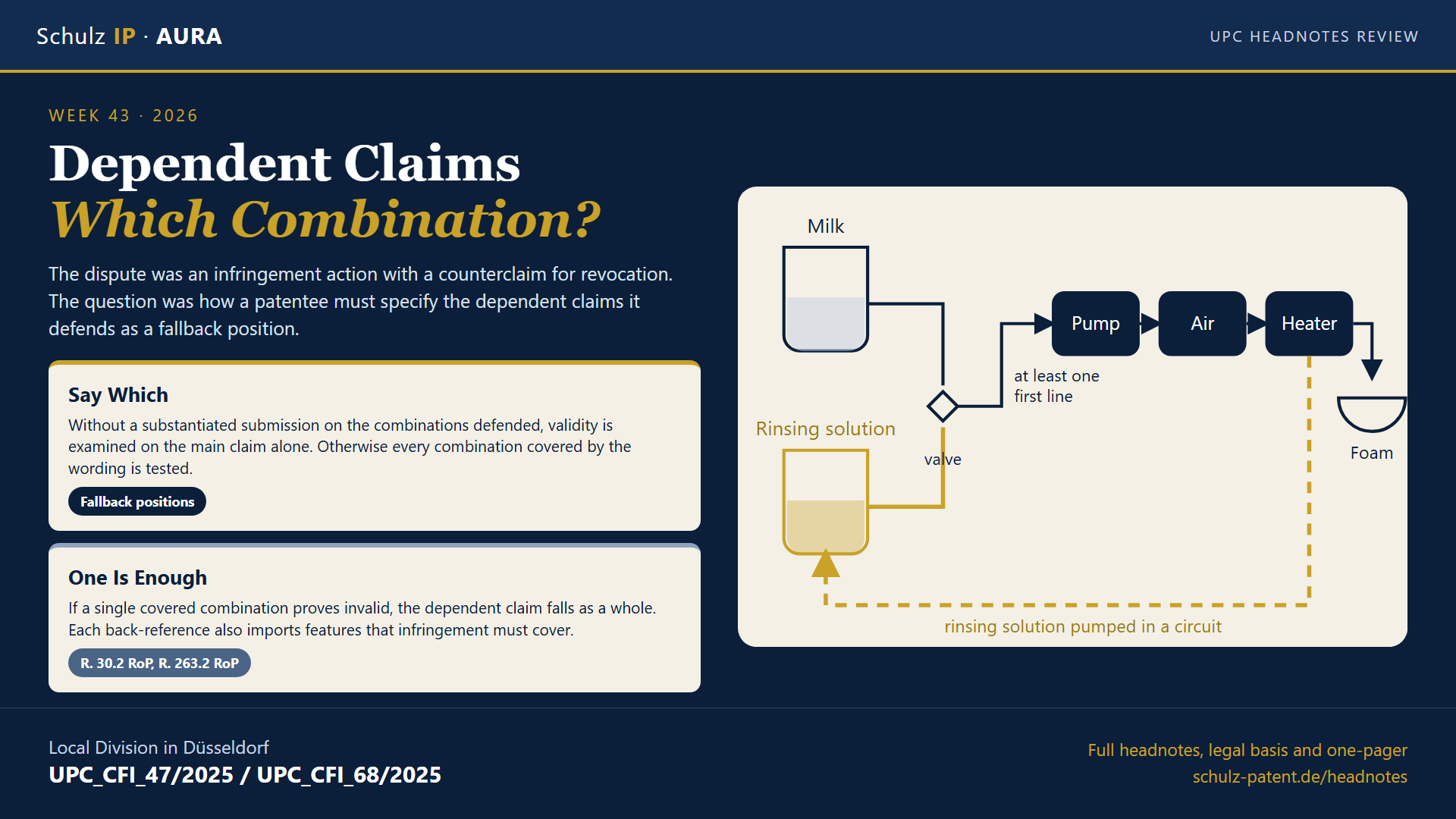
Here is a situation you may recognise. Your patent protects a milk frother for coffee machines, and claim 12's special feature is that it cleans itself: a rinsing solution is pumped in a circuit through the lines, the pump, the air element and the heater. In your statement of claim you assert claim 1 and the cleaning claims 12 and 13. You do not assert claim 11, which sits between them.
The counterclaim for revocation takes claim 1 down, while claim 12 survives. Claim 12 refers back to claim 11, so it carries that claim's feature as well: the device can be connected to the rinsing solution container through at least one first line. Your infringement case must therefore cover a claim you never asserted.
In UPC_CFI_47/2025 and UPC_CFI_68/2025 the Local Division in Düsseldorf upheld claim 12 and dismissed the infringement action. The pleading never said which line of the attacked device can be connected to the rinsing container. For claim 1 it had named one line, and for claim 12 two different ones, which did not fit together. The patent survives in limited form, and the case is still lost.
The UPC published 4 headnote decisions in week 43/2026. Here is what they decide, and which provision they interpret.
UPC_CFI_47/2025 / UPC_CFI_68/2025 — Local Division in Düsseldorf, infringement action and counterclaim for revocation
R. 263.2 RoP, R. 30.2 RoP, R. 9.2 RoP · EP 3 281 569, modular foam unit
Infringement requests based on the scope of auxiliary requests cannot be introduced for the first time in the interim procedure. Where dependent claims or amended wordings become auxiliary requests, the infringement action must be adapted at the same time. Where multiple back-references are not substantiated, validity is examined across every combination the wording covers.
UPC-CoA-582/2025 and nine related appeals — Court of Appeal Luxembourg, infringement action and counterclaim for revocation
Art. 54(2) EPC · EP 3 388 490, decorating natural leather
A manufacturing method of a publicly used product is made available to the public by use. This applies where the skilled person could establish the method without undue burden by analysing the product. The public use of the product therefore carries the method with it.
UPC-CoA-149/2026 / UPC-CoA-150/2026 — Court of Appeal Luxembourg, procedural order
Art. 49(6) UPCA, R. 334(h) RoP · EP 3 762 212, disposable 3D printer cartridge
An application to change the language of proceedings before the Central Division is a procedural application, not a claim. Its rejection is therefore not a summary dismissal of a claim. The Rules of Procedure provide for no change of language before the Central Division, because the language of the patent governs without exception.
UPC_CFI_2221/2026 — Central Division in Milan, procedural order
R. 360 RoP, Art. 113(2) EPC · EP 3 689 365, use of long-acting GLP-1 peptides
The Court has no jurisdiction over a claim that a composition was obvious at a given priority date, independently of a patent right. It does have jurisdiction to protect the effectiveness of its own proceedings, including against the abusive use of divisional applications. It may therefore decline to dispose of an action under R. 360 RoP, and it may restrain a party from withdrawing its approval of the text of the patent.
All 4 decisions are in AURA, linked to the article or rule they interpret, together with the headnotes in English, the legal basis and a One-Pager. Open the AURA dashboard.
New in the archive: 25 headnote decisions from August 2024. The early case law on confidentiality clubs, security for costs and the language of proceedings is now a click away, in English and linked to the provisions.
Short videos on the individual decisions: @schulz_ip on Instagram and YouTube.
For informational purposes only. This is not legal advice.
UPC Headnotes Review · Every UPC headnote decision, linked to the provision it interprets.
Suppose your company has just missed the deadline for its cost application, although it had won on appeal. Your firm applies for re-establishment of rights, because an assistant made the diary entry without a second check. The Local Division refuses, since it expects a lawyer to supervise time limits in a new court system. You now want the Court of Appeal to review that refusal.
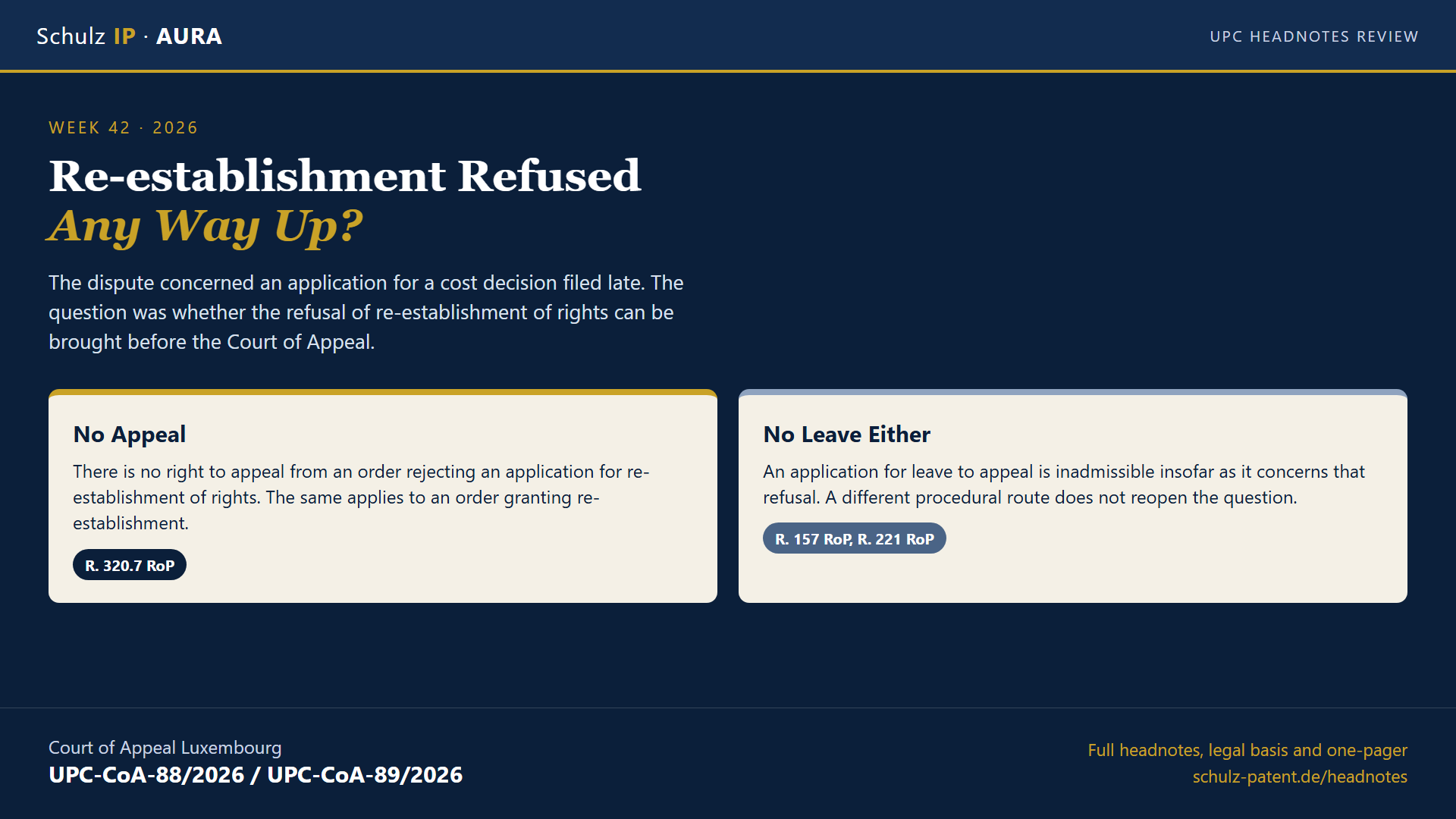
R. 320.7 RoP closes that route, because it allows no appeal against an order on re-establishment of rights. The route stays closed when the same complaint arrives as an application for leave to appeal under R. 157 RoP in conjunction with R. 221 RoP. The Court examines that bar at the admissibility stage, before it looks at any reason put forward for granting leave.
In UPC-CoA-88/2026 and UPC-CoA-89/2026 the Court of Appeal dismissed the application as inadmissible. The place where the diary sits therefore decides the claim, because a refused re-establishment is final. Two further points travel beyond this case. A retroactive extension is not available for this time limit, since an application under R. 320 RoP takes precedence. And the question of which instance is competent stays with the representative, because it is a question of law.
The UPC published 1 headnote decision in week 42/2026. Here is what it decides, and which provision it interprets.
UPC-CoA-88/2026 / UPC-CoA-89/2026 — Court of Appeal Luxembourg, procedural order
R. 157 RoP, R. 221 RoP, R. 320.7 RoP · EP 2 548 648, mill for comminuting of material
An application for leave to appeal is inadmissible insofar as it concerns the rejection of an application for re-establishment of rights. Under Rule 320.7 of the Rules of Procedure there is no right to appeal from an order rejecting or granting re-establishment of rights. This means that the leave to appeal route under Rules 157 and 221 cannot be used to reopen that question.
The decision is in AURA, linked to the rule it interprets, together with the headnotes in English, the legal basis and a One-Pager. Open the AURA dashboard.
Short videos on the individual decisions: @schulz_ip on Instagram and YouTube.
For informational purposes only. This is not legal advice.
UPC Headnotes Review · Every UPC headnote decision, linked to the provision it interprets.
It is Monday morning, and you review technical measurements your team will rely on in an infringement action. Your engineers tested your competitor's sniffing leak detector. The question was whether its buffer chamber permits the homogeneous mixing of gases your patent requires. The test data shows a delay between test gas being released outside the housing and being measured at the gas analyzer. However, the tests do not reflect that the buffer chamber causes the mixing of gases. You wonder: will the opponent need to run their own tests, or can they simply attack your measurements instead?
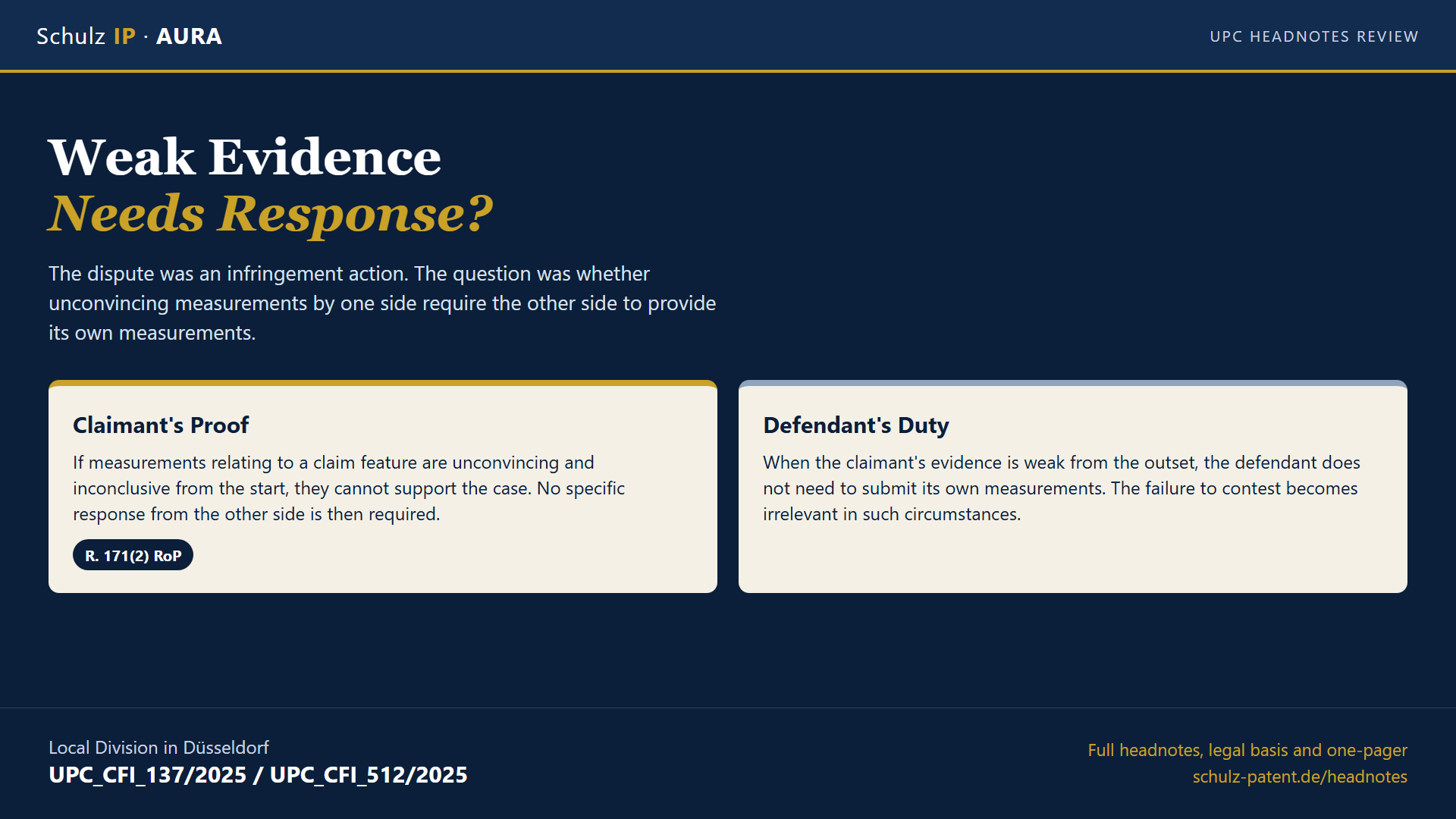
R. 171(2) RoP deems any uncontested factual statement true between parties. However, this rule only applies if your statement was conclusive from the outset. If your measurements are unconvincing or inconclusive initially, no specific contesting by the opponent is required at all. Therefore, your measurements must link the effect to a structural feature of the claim. Here that means showing the buffer chamber causes the homogeneous mixing of gases. Merely showing the observed effect is not sufficient. The opponent may attack conclusiveness instead of running their own tests, but only where the deficiency is obvious.
In UPC_CFI_137 and 512/2025, the Court found the measurements inconclusive. They did not link the buffer chamber with the delay and mixing of gases. The Court left open whether the defendant should have contested the measurements more specifically. As a result, claimants should design measurements in a way that test data can be attributed to the respective claim feature. Defendants should still contest specifically whenever the measurements look conclusive.
The UPC published 1 headnote decision in week 41/2026. Here is what it decides, and which provision it interprets.
UPC_CFI_137/2025 / UPC_CFI_512/2025 — Local Division in Düsseldorf, Infringement action and counterclaim for revocation
R. 171 RoP · EP 3 567 356 B1, sniffing leak detector with switching valve and buffer chamber
Claimant's measurements may be unconvincing and inconclusive from the outset. In such cases, the defendant need not provide its own measurements. This means that specific contesting under Rule 171(2) of the Rules of Procedure is not required in such circumstances.
The decision is in AURA, linked to the rule it interprets, together with the headnotes in English, the legal basis and a One-Pager. Open the AURA dashboard.
Short videos on the individual decisions: @schulz_ip on Instagram and YouTube.
For informational purposes only. This is not legal advice.
UPC Headnotes Review · Every UPC headnote decision, linked to the provision it interprets.
You are the person who must decide whether to pursue a suspected patent infringement case. Your competitor has just launched tissue paper products that closely resemble your patented Miscanthus pulp technology. Your team needs proof that their products actually use your invention. However, the competitor refuses to cooperate, and you cannot access their production facilities or technical documentation. Time is running out before evidence disappears or gets destroyed.
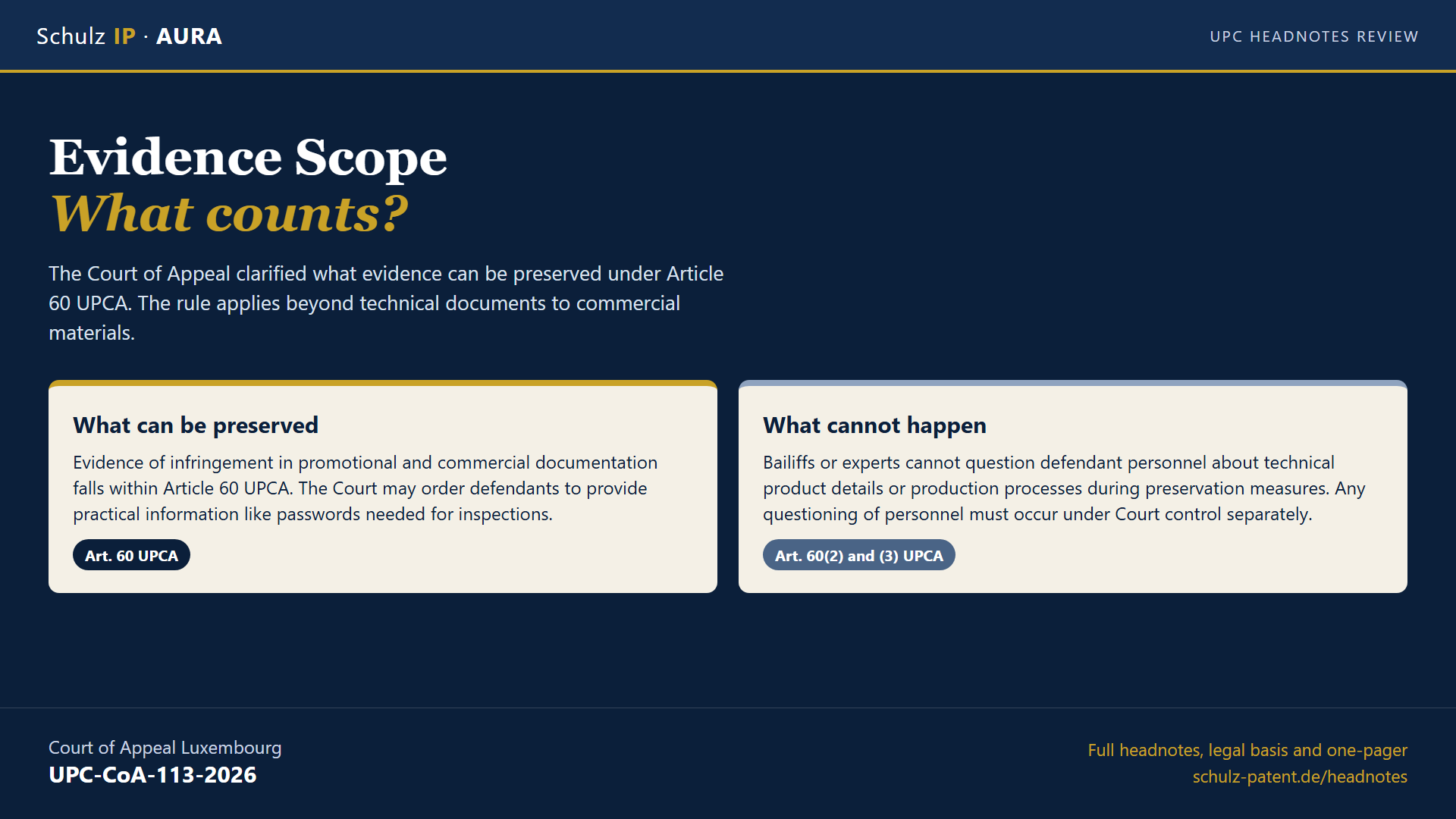
The rule allows you to ask a court to preserve evidence before filing suit. This preservation can cover promotional materials, commercial documents, and even some operational information. However, the court will not allow bailiffs to interrogate the defendant's staff about technical secrets. Therefore, you can only compel practical access like passwords needed for inspecting digital files. Importantly, your need to secure evidence generally outweighs the defendant's concerns, even if they claim prior use rights.
The Court of Appeal held that evidence preservation applies broadly to promotional and commercial documentation containing infringement indicators. The court rejected attempts to question personnel but permitted orders requiring the defendant to provide necessary access information like passwords. Prior use rights cannot block preservation measures unless the infringement claim is clearly doomed on summary review. Take away: secure evidence before suit, but expect limits on what questions bailiffs can ask during inspection.
AURA grew by 18 decisions from July 2024 this week, so the archive of earlier case law keeps filling up. The Court itself published no new headnote decision.
Every decision is in AURA, linked to the article or rule it interprets, together with the headnotes in English, the legal basis and a One-Pager. Open the AURA dashboard.
Short videos on the individual decisions: @schulz_ip on Instagram and YouTube.
For informational purposes only. This is not legal advice.
UPC Headnotes Review · Every UPC headnote decision, linked to the provision it interprets.
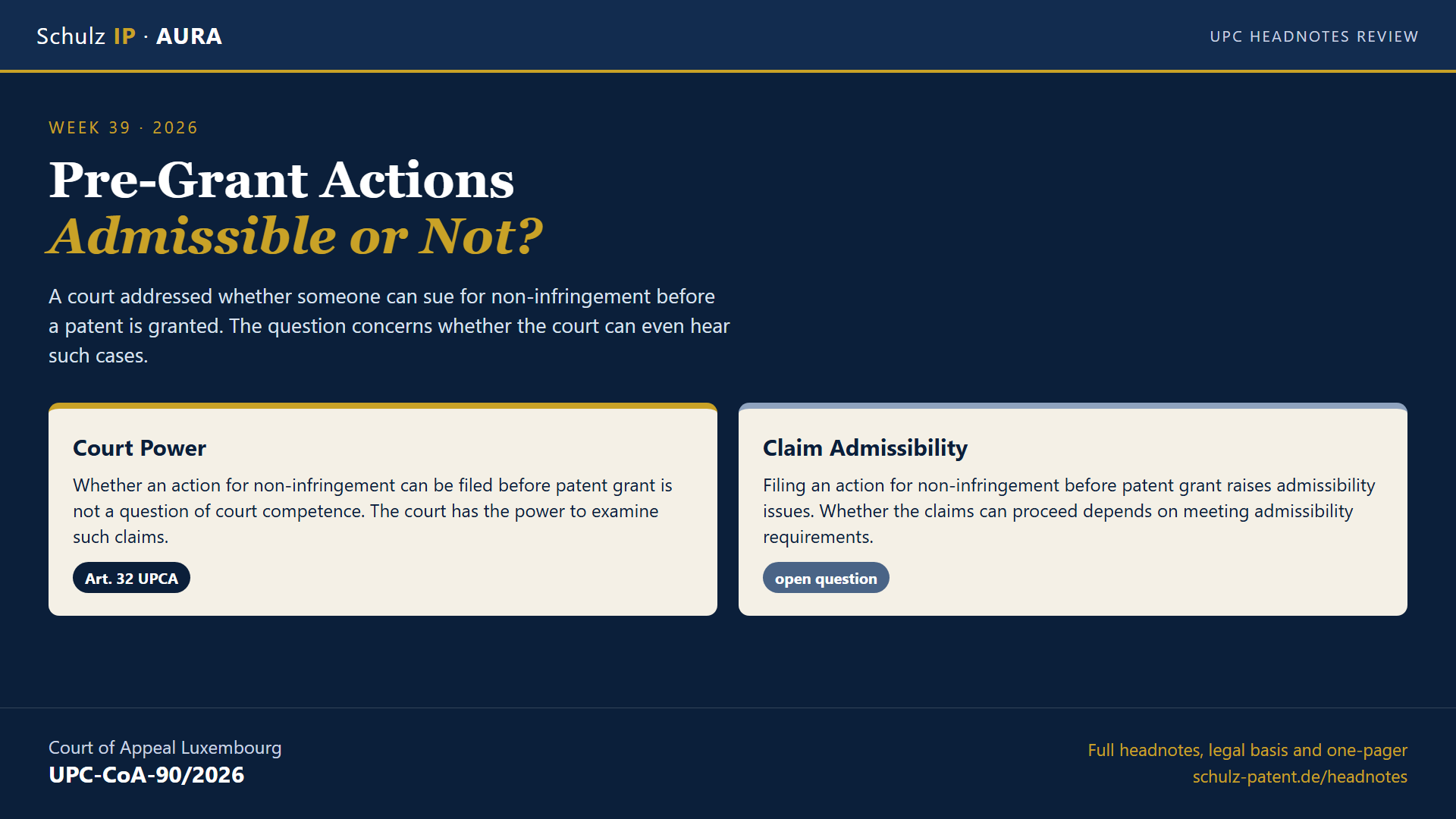
Picture the moment when you file for a declaration of non-infringement, weeks before the patents issue. Your opponent does not answer on the merits. Instead it objects that the Court has no competence at all. It argues that the Agreement speaks of patents and never mentions applications. Further, it insists that competence is judged on the day the action is filed.
Article 32(1) UPCA lists the actions for which the Court has exclusive competence. Declarations of non-infringement of patents are among them, under Article 32(1)(b) UPCA. Importantly, the Court reads your request by your actual intent, not by its literal wording. If you seek the declaration for the titles once granted, the action stays within that provision. Therefore their pending status at filing does not turn it into an action on applications.
The Court of Appeal rejected the preliminary objection. The claimant had defined both titles jointly as the Patents, with an intention to grant already issued for one. Therefore the action fell within Article 32(1)(b) UPCA, and the objection on competence failed. However, whether the claim came too early is a question of admissibility instead. Rules 61 and 63 may require a granted patent, and that point stays for the further proceedings.
The UPC published 2 headnote decisions in week 39/2026. Here is what they decide, and which provision they interpret.
UPC_CFI_029/2026 / UPC_CFI_1934/2026 / UPC_CFI_1940/2026 — Local Division in Brussels, counterclaim for revocation
R. 305 RoP · EP 3 689 383, chimeric antigen receptors targeting b-cell maturation antigen
The Rules of Procedure do not permit aggressive interventions. This means an intervener cannot direct claims against parties differently from those it supports. Such interventions lack procedural standing under UPC rules.
UPC-CoA-90/2026 — Court of Appeal Luxembourg, procedural order
Art. 32 UPCA · EP 4 594 194, labelling module configured for labelling with partial labels
Pre-grant declarations of non-infringement raise an admissibility question. This is not a question of the court's competence. Rather, the issue concerns whether the instituted claims are legally permissible. The UPC must therefore assess admissibility of the claims separately from its jurisdictional authority.
All 2 decisions are in AURA, linked to the article or rule they interpret, together with the headnotes in English, the legal basis and a One-Pager: https://www.schulz-patent.de/headnotes/?utm_source=linkedin&utm_medium=newsletter
Short videos on the individual decisions: @schulz_ip on Instagram and YouTube.
For informational purposes only. This is not legal advice.
UPC Headnotes Review · Every UPC headnote decision, linked to the provision it interprets.
Imagine you file a patent infringement claim at the UPC, confident in your case. Your opponent immediately asks the Court to order you to post security for their legal costs. You're an SME with modest resources and limited current operations. The Court might order you to pay EUR 75,000 upfront before trial even begins. Now you face a choice: fund the security or abandon your patent claim.
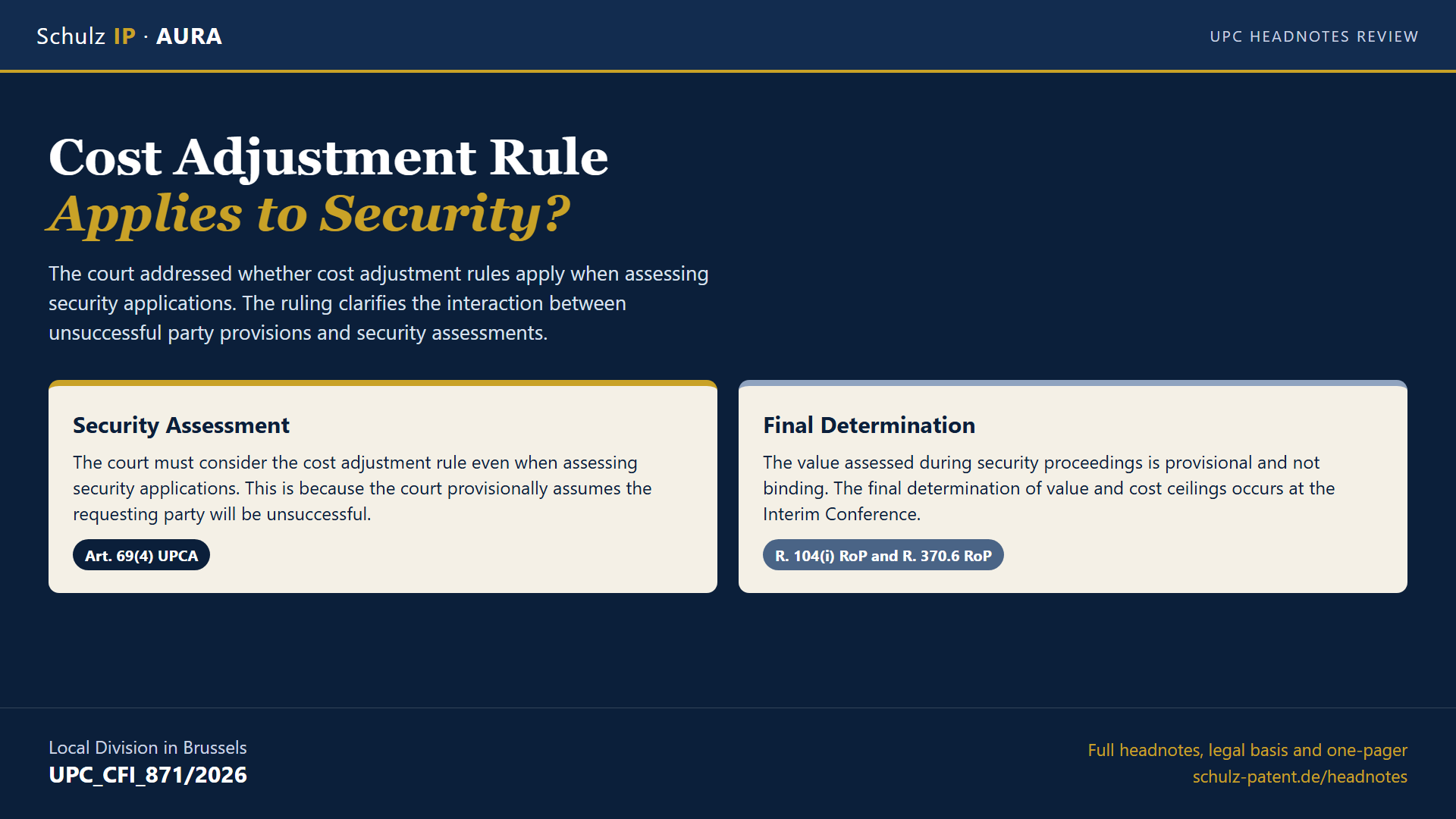
The Court can order security under Article 69(4) UPCA. However, the Court must also consider whether you face economic hardship under Article 2(2) of the Cost Scale. Therefore, you should raise hardship arguments immediately in the security proceedings. Importantly, you must prove actual operational activity, staff, and turnover. Simply being an SME is not enough to convince the Court.
The Court valued this infringement claim at EUR 1,000,000 and set a legal cost ceiling of EUR 112,000. As a result, the security order required EUR 75,000 deposit. The claimant's SME status alone did not lower the ceiling. The key takeaway: submit audited accounts showing real operations and employees when claiming economic hardship.
The UPC published 3 headnote decisions in week 38/2026. Here is what they decide, and which provision they interpret.
UPC-CoA-919/2025 / UPC-CoA-920/2025 — Court of Appeal Luxembourg, procedural order
R. 362 RoP · EP 3 215 288, sintered metal preparation and its use for joining components
According to the headnotes, an absolute bar to proceedings is a final legal circumstance that prevents court action. Importantly, this bar cannot be fixed by parties through later submissions or performance. Therefore, it operates independently of the parties' control.
UPC_CFI_871/2026 — Local Division in Brussels, procedural order
Art. 69 UPCA · EP 3 841 735, method and system for improving the print quality
Article 2(2) of the Scale of Recoverable Costs allows adjustment when a requesting party is unsuccessful. The Court must apply this provision when assessing security applications as well. This is because the Court assumes from the outset that the requesting party will be unsuccessful. Therefore, the provision on liability to bear costs applies to security assessments too. Additionally, the value of a dispute is definitively determined during the Interim Conference. However, any value assessment made when considering a security application remains provisional only. This means that such a provisional assessment does not bind the Court or Judge-Rapporteur later. In particular, it does not bind them when they finally determine the claim value or set cost ceilings.
UPC-CoA-121/2026 — Court of Appeal Luxembourg, costs order
Art. 74 UPCA · EP 3 854 403, use of substituted aminopropionate compounds in treatment of sars-cov-2 infection
Appeals against revocation decisions automatically suspend enforcement. This automatic suspensive effect applies because validity decisions affect all parties, not just those involved. The suspended patent's legal status remains protected while the appeal proceeds. However, suspensive effect may also be granted at the Court's discretion in other circumstances.
All 3 decisions are in AURA, linked to the article or rule they interpret, together with the headnotes in English, the legal basis and a One-Pager: https://www.schulz-patent.de/headnotes/?utm_source=linkedin&utm_medium=newsletter
Short videos on the individual decisions: @schulz_ip on Instagram and YouTube.
For informational purposes only. This is not legal advice.
Kontakt